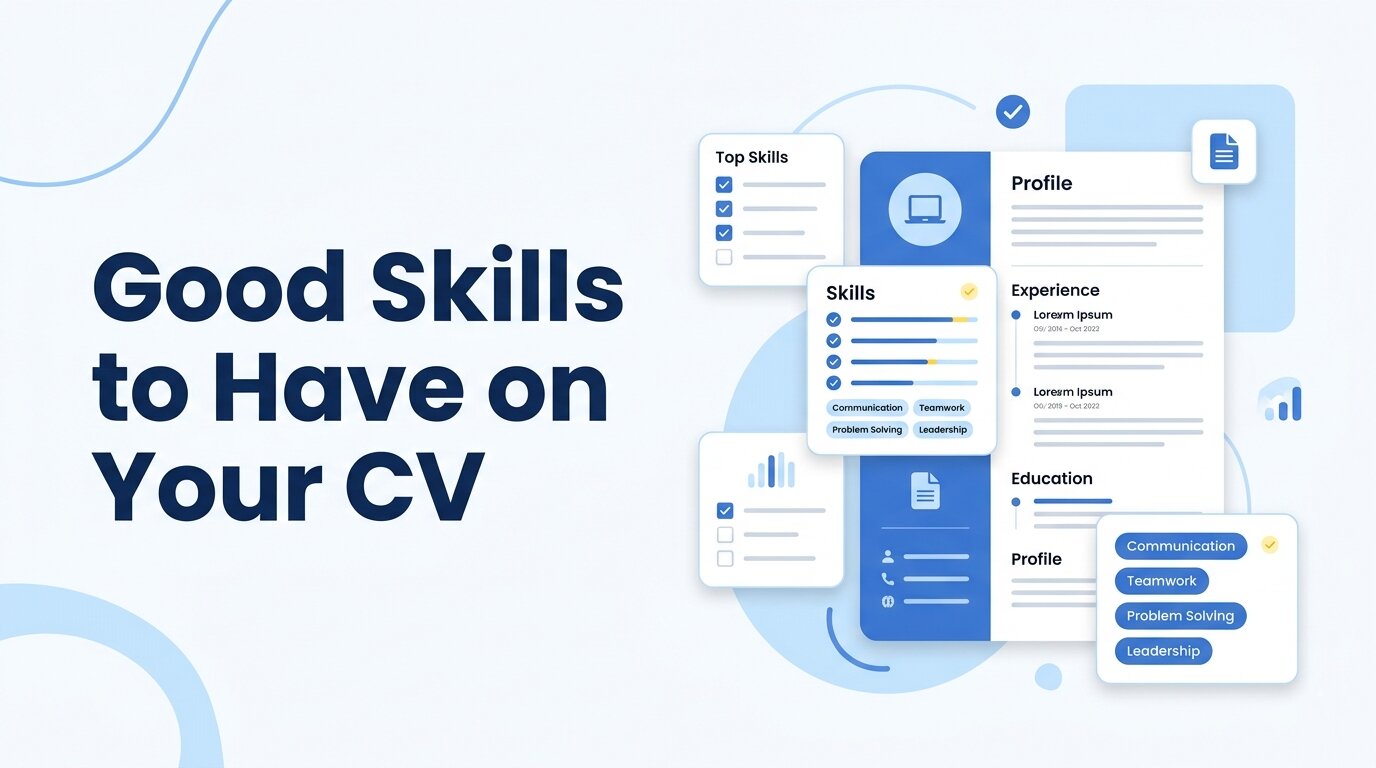
So what are good skills to have, and how do you present them in the right way?
In this guide, you will learn which skills employers look for, how to choose the right ones for your CV, and how to show them with real examples. If you want to get noticed and move ahead in your job search, this will give you a clear starting point.
What Does “Good Skills to Have” Really Mean in 2026?
In 2026, the idea of a strong CV has shifted. Employers are moving away from the traditional CV that focuses only on degrees and job titles. Instead, hiring is becoming more skills-based. Employers are increasingly interested in what you can do in real situations, not just what you have studied.
This means simply listing skills is no longer enough. Anyone can add communication or teamwork to a CV. What matters is proving those skills with clear examples and measurable results. Recruiters want to see how you have used your skills to solve problems, improve processes, or add value.
Relevance is also key. Employers look for skills that match the job role, not a long list of generic points. A focused, well-structured CV that highlights relevant skills will always stand out more than one that tries to include everything.
What Do Employers and Recruiters Look for in a CV in 2026?
In 2026, both recruiters and hiring managers review a CV with a clear goal: find candidates who can add value quickly. A recruiter often does the first scan, sometimes in seconds, while hiring managers look deeper to assess fit and potential. This is why your CV needs to be clear, relevant, and easy to understand.
Most companies now use an applicant tracking system, also known as ats, to filter applications. These tracking systems scan your CV for keywords from the job description before a human even sees it. If your CV does not match those keywords, it may not reach the next stage.
Readability also matters. A clean format, clear headings, and simple structure make your CV easy to read and help recruiters find key information fast. Along with this, personal branding and digital presence are becoming important. Employers often check your online profile to understand your skills and professionalism beyond your CV.
Types of Skills Employers Look for in 2026
Employers in 2026 expect a balance of different skills, not just one type. A strong CV should reflect both your personality and your practical ability.
Soft skills still matter. Communication, adaptability, and problem-solving help you work effectively in teams and handle real workplace situations. These skills show how you think, respond, and collaborate.
Technical skills are just as important. Employers want candidates who can work with tools like Excel, understand data analysis, and use industry-specific systems. These are the skills that help you perform tasks efficiently from day one.
Transferable skills also play a key role. These are skills you can carry from one role to another, such as organisation, time management, and analytical thinking.
Most employers want a mix. They are not just hiring for knowledge. They are hiring someone who can apply that knowledge in real situations and contribute from the start.
Good Skills to Have on Your CV in 2026
When it comes to building a strong CV in 2026, certain skills stand out across industries. These are not just buzzwords. They reflect how you perform in real work situations.
Communication is one of the most important skills. Employers expect you to explain ideas clearly, whether in meetings, emails, or reports. In roles like audit or finance, this could mean presenting findings or explaining data to non-technical teams.
Problem-solving is another key skill, especially when supported with practical problem-solving examples on your CV. Businesses face challenges every day, and employers want people who can think logically and find practical solutions. For example, identifying errors in financial data or improving a reporting process shows strong problem-solving ability.
Data analysis is now a core requirement in many roles. Being able to work with data, identify trends, and support decisions adds real value. This often goes hand in hand with digital literacy, such as using Excel, dashboards, or basic analytics tools.
Adaptability is equally important. Work environments change quickly, and employers prefer candidates who can adjust and learn new systems or processes without delay.
The key is to focus on relevant skills, not generic ones. Your CV should match the role you are applying for and clearly show how your skills apply in real scenarios.
Listing skills is easy; showing proof is what gets you shortlisted.
Skills Required for Audit and Finance Roles
If you are targeting audit or finance roles, your CV should highlight skills that show accuracy, logic, and practical understanding of data.
Attention to detail is essential. Even small errors in financial records can create major issues. Employers expect you to review data carefully and spot inconsistencies before they become problems.
Analytical thinking is equally important. In audit roles, you are not just checking numbers. You are understanding patterns, identifying risks, and explaining what the data actually means for the business.
Strong knowledge of tools like Excel and basic accounting software gives you a clear advantage. These tools help you work efficiently and handle large volumes of financial data with confidence.
Understanding financial data is at the core of these roles. You should be able to read reports, interpret figures, and support decision-making.
Most importantly, try to show measurable achievements in your work. Even small examples, like improving accuracy or reducing errors, can help employers see your real impact.
How to Choose the Right Skills for Your CV
Choosing the right skills for your CV starts with one simple step: carefully reading the job description. Most candidates skip this and end up listing generic skills that do not match the role. Employers want to see relevant skills that align with what they are hiring for.
Look for keywords from the job description and use them naturally in your CV. These keywords often reflect what recruiters and applicant tracking systems are scanning for. If your CV matches the language of the role, it has a better chance of getting noticed.
Tailoring your CV for each application is important. A CV for an audit role should not look the same as one for a marketing role. Focus on skills that directly connect to the job requirements.
Avoid a one-size-fits-all approach. A targeted CV that highlights the right skills will always perform better than a generic one sent to multiple roles.
How to Show Your Skills with Real Examples
Listing skills on a CV is not enough. You need to show how you have actually used them in real situations. This is where most candidates fall short.
Focus on measurable results wherever possible. Instead of saying you have strong analytical skills, show what you achieved. For example, “Improved reporting accuracy by 20%” gives a clear picture of your impact. Numbers help employers understand the value you bring.
Always highlight impact, not just responsibility. Writing “Responsible for preparing reports” is weak. Instead, explain what changed because of your work. Did you save time, reduce errors, or improve processes?
Use bullet points smartly to make your CV easy to read. Keep each point short and focused on one achievement. This helps recruiters quickly scan your CV and pick out key results.
When you present your skills with real examples, your CV becomes much more convincing and easier to trust.
Tools and Skills That Give You an Edge
In a digital-first workplace, tools can set your CV apart. Employers expect you to be comfortable with everyday systems, not learn from scratch after joining.
Excel is still one of the most useful tools. It helps with data analysis, reporting, and organising information. Power BI and similar tools add another layer by helping you create dashboards and present insights clearly. Basic knowledge of accounting tools also gives you an advantage in finance and audit roles.
Digital literacy matters more than ever. You should be confident using software, understanding data, and adapting to new systems quickly.
These tools do more than improve efficiency. They help you stand out. When employers see that you can work with real tools from day one, they are more likely to shortlist your CV.
Step-by-Step: How to Build Strong Skills for Your CV
Building strong skills for your CV does not happen overnight. It is a step-by-step process that requires focus and consistency.
Start by understanding what employers expect. Look at job descriptions in your target field and identify the skills that appear repeatedly. This gives you a clear direction instead of guessing.
Next, identify your gaps. Be honest about what you are missing and what needs improvement. This helps you prioritise the right areas instead of trying to learn everything at once.
Learn practical tools like Excel, reporting tools, or basic accounting systems. These are skills you can apply directly in real work situations.
Try to gain internships or work experience wherever possible. Even short-term roles can give you exposure and help you build confidence.
Work on small projects. For example, create reports, analyse data, or solve real problems. This helps you build proof for your CV.
Finally, improve based on feedback. Learn from mistakes and keep refining your skills.
Most candidates focus only on listing skills but ignore proving them with real examples.
How to Build Skills Without Experience
You don’t need a full-time job to start building useful skills. There are practical ways to gain experience even if you are just starting out.
Internships are one of the best options. Even short-term roles help you understand real work environments and give you examples to add to your CV. If internships are not available, look for online projects. You can practise data analysis, create reports, or work on case studies to build relevant skills.
Volunteer work is another strong option. Helping with small tasks in organisations or student groups can give you real responsibility and exposure.
Focus on practical learning. Try to apply what you learn instead of only reading about it. The more real examples you have, the easier it becomes to prove your skills and stand out to employers.
Common Mistakes When Adding Skills to a CV
Many candidates weaken their CV by making simple mistakes in the skills section. The most common one is listing skills without proof. Writing communication or teamwork means very little if you do not show how you have used them in real situations.
Another issue is adding too many generic skills. A long list may look impressive at first, but it often lacks relevance. Employers prefer a few well-chosen skills that clearly match the role.
Not tailoring your CV is another mistake. Sending the same CV for every job reduces your chances of getting noticed. Each role requires a different focus.
Poor formatting and readability also create problems. If your CV is difficult to scan, recruiters may miss important information. Keep your structure simple, clear, and easy to read.
How to Know If Your CV Skills Are Strong Enough
A simple way to check your CV skills is to ask a few honest questions. First, can you prove them? If you cannot support a skill with a real example or result, it may not be strong enough to include.
Next, are your skills relevant to the job opportunities you are applying for? A skill only adds value if it connects directly to the role. Focus on what the employer is actually looking for.
Finally, would a recruiter notice your skills quickly? Your CV profiles and key strengths should be easy to spot within seconds. If your skills are clear, relevant, and backed by proof, you are on the right track.
Frequently Asked Questions
What are good skills to have on a CV?
Good skills are those that match the job you are applying for and show your ability to perform tasks effectively. These include communication, problem-solving, data analysis, digital literacy, and role-specific technical skills.
How to show skills without experience?
You can use examples from internships, academic projects, or volunteer work. Focus on what you did and the outcome. Even small achievements can help prove your skills.
Should I include both soft and technical skills?
Yes, a strong CV should include a mix. Soft skills show how you work with others, while technical skills show your ability to perform specific tasks.
What skills are important for audit jobs?
Key skills include attention to detail, analytical thinking, Excel proficiency, understanding financial data, and the ability to identify and solve problems.
Key Takeaways
- Skills matter more than ever in 2026, and employers focus on what you can actually do, not just your qualifications
- Proof is more important than listing, so always support your skills with real examples and practical examples of skills for CV applications.
- Tailoring your CV for each role improves relevance and increases your chances of getting noticed
- Real examples help recruiters quickly understand your value and increase shortlist chances
- A strong CV format with clear structure and readability makes it easier for employers to scan and assess your profile quickly
Final CTA
Improving your CV is not about adding more content. It is about presenting the right skills in a clear and convincing way. When you focus on relevant skills and support them with real examples, your chances of getting shortlisted improve significantly.
If you want to take this further, explore more CV writing tips on Internwise UK to understand what employers expect and how to structure your CV effectively. Small improvements can make a big difference.
Want to stand out to employers? Build a strong CV and showcase your skills effectively. Explore more CV writing tips on Internwise UK and take your next step with confidence.
Was this article helpful?


Candidate Journey
(select your stage)
Choose the Right Career
See allStart Your Job Search
See allGet Ready for Work
See allImprove Your Soft Skills
See allWrite a CV That Gets You Noticed
See allBuild the Skills You Need to Succeed
See allInternship Application Tips
See allInterview Preparation
See allIndustry Internships
See all
What's Next?
Similar articles
Problem Solving Examples to Showcase on Your CV
The job market is competitive, and a strong CV alone is not enough to stand out. Employers are not just looking for qualifications. They want candidates who can handle challenges and find practical solutions. T...
Read Now
CV Profiles That Make a Strong First Impression
Most CVs get ignored within seconds, not because candidates lack skills, but because their opening section fails to grab attention. That first impression matters more than people think. Strong CV profiles can q...
Read Now
Best Leadership Skills Examples for Your CV
Most candidates say they have leadership skills. Very few actually prove it. That’s the difference between getting shortlisted and getting ignored. Leadership skills in a CV are not just about managing people...
Read Now
Best Cover Letter Opening Lines to Make a Strong Impression
Most cover letters fail in the first few lines. Not because candidates lack skills, but because they don’t know how to start strong. A weak opening can make an employer lose interest before they even reach yo...
Read Now
Investment Banking CV Template for Students and Graduates
Breaking into an investment bank is highly competitive. Thousands of students and graduates apply for a limited number of roles, and recruiters often review hundreds of applications for a single position. In mo...
Read Now
| Vacancy | Location (Sector) | Job Type | Date Published | |
|---|---|---|---|---|

Accounts Admin Internship at M&K AccountantsM N K ACCOUNTANTS LTD |
London - Camden , Central London Accountancy |
Full-time | Sep 21, 2026 | View |
Marketing InternshipM N K ACCOUNTANTS LTD |
Camden Town / London, Central London Marketing / Advertising / Social Media |
Part-time | Sep 21, 2026 | View |

Delegate Relations Executive (Sales)QATALYST GLOBAL LIMITED |
London / Hybrid , Greater London Business Management / Development, Sales |
Part-time/Full-time | Sep 19, 2026 | View |
Graduate Conference Producer (Events)QATALYST GLOBAL LIMITED |
London / Hybrid , Greater London Project Management, Events |
Full-time | Sep 18, 2026 | View |

Social Media and Content Intern – Home StagingLONDON PROPERTY STAGING LTD |
London, Greater London Photography / Videography, Marketing / Advertising / Social Media, Architecture / Interior Design |
Part-time | Sep 11, 2026 | View |

Sales & Marketing InternshipKARMAH LTD |
London, Central London Sales, Marketing / Advertising / Social Media, Business Management / Development |
Part-time/Full-time | Sep 09, 2026 | View |
Brand Design Internship (Part-Time)JBROWN GLOBAL LIMITED |
London, Central London Design / Web Design / Graphic Design |
Part-time | Sep 07, 2026 | View |
Real Estate Surveying InternshipJBROWN GLOBAL LIMITED |
London, Central London Construction, Surveying, Property Management / Real Estate |
Part-time/Full-time | Sep 07, 2026 | View |
Real Estate Marketing Internship (Paid Part time)JBROWN GLOBAL LIMITED |
Manchester, North West England Marketing / Advertising / Social Media |
Part-time | Sep 07, 2026 | View |

Fund Operations InternGRS CAPITAL PARTNERS LIMITED |
London, Central London Financial Services / Banking |
Full-time | Aug 31, 2026 | View |
| Vacancy | Sector | Location | Job Type | Date Published |
|---|---|---|---|---|

Structural EngineerCONTINENTAL MARKET TRADING LIMITED |
Engineering |
London, Greater London | Full-time | May 28, 2026 |

Accounting and Finance ExecutiveINTERCITY HIRE LTD |
Financial Services / Banking, Accountancy |
Solihull, West Midlands | Full-time | Sep 11, 2025 |

PR & Marketing InternH R DRINKS (WHOLESALE) LTD |
Public Relations (PR) & Communications |
Stratford, London, Greater London | Part-time/Full-time | Aug 18, 2025 |

Business Development Intern (Event Services)STREETFOODMARKETS LTD |
Events, Hospitality / Catering |
London, Central London | Full-time | Mar 15, 2025 |
Supplier Onboarding Specialist InternshipSTREETFOODMARKETS LTD |
Freight / Logistics / Procurement, Hospitality / Catering |
London, Central London | Full-time | Mar 15, 2025 |

Social Media ManagementTISOVA LTD |
Security & Defence, Marketing / Advertising / Social Media, Information Technology (IT) / Web Development |
London, Greater London | Part-time | Jan 22, 2025 |

Sales and Marketing InternONEWAYX LTD |
Sales, Marketing / Advertising / Social Media, Events, Information Technology (IT) / Web Development, Fashion & Luxury |
London, Central London | Part-time | Nov 01, 2024 |

Sustainability Focused Policy Internship (China focus)ISEAL ALLIANCE |
Charity / NGO / Social Services / Non Profit, Agriculture & Environment |
London, Greater London | Part-time | Oct 11, 2024 |
Global Affairs InternshipBLINK CHARGING UK LIMITED |
Public Sector / Government, Utilities (Energy, Water, Gas), Automotive / Transportation |
Leeds, North West England | Full-time | Jul 12, 2024 |

Guest Relations and Reservations AgentDWELLERS DELIGHT LIVINNG LTD. |
Travel & Leisure, Customer Service, Hospitality / Catering |
London, Greater London | Full-time | May 15, 2024 |
| Sector | Vacancies | |
|---|---|---|
Market Research / Analysis |
216 | View |
Engineering |
68 | View |
Architecture / Interior Design |
151 | View |
Construction |
17 | View |
Project Management |
119 | View |
Events |
333 | View |
Scientific / Pharmaceutical / Biotech |
14 | View |
Sales |
480 | View |
Marketing / Advertising / Social Media |
2751 | View |
Administration & PA |
478 | View |
Hospitality / Catering |
83 | View |
Security & Defence |
4 | View |
Telecommunications |
13 | View |
Freight / Logistics / Procurement |
40 | View |
Charity / NGO / Social Services / Non Profit |
230 | View |
HR & Recruitment |
219 | View |
Consulting |
143 | View |
Training & Development |
42 | View |
Health & Social Services |
75 | View |
Customer Service |
159 | View |
| Region | Vacancies | |
|---|---|---|
Central London |
5297 | View |
Greater London |
1268 | View |
South East England |
372 | View |
South West England |
95 | View |
East of England |
46 | View |
East Midlands |
51 | View |
West Midlands |
169 | View |
North East England |
9 | View |
North West England |
145 | View |
Yorkshire and the Humber |
34 | View |
Scotland |
46 | View |
Wales |
25 | View |


